San Antonio runs an annual average of 66.9% relative humidity with a dew point of 55.0 °F. Hold 40–50% indoors and the rest of this page is how.
- Annual relative humidity
- 66.9%
- Annual dew point
- 55.0 °F
- Annual rainfall
- 32.38 in
- Average July high
- 94.9 °F
- Indoor target
- 40–50%
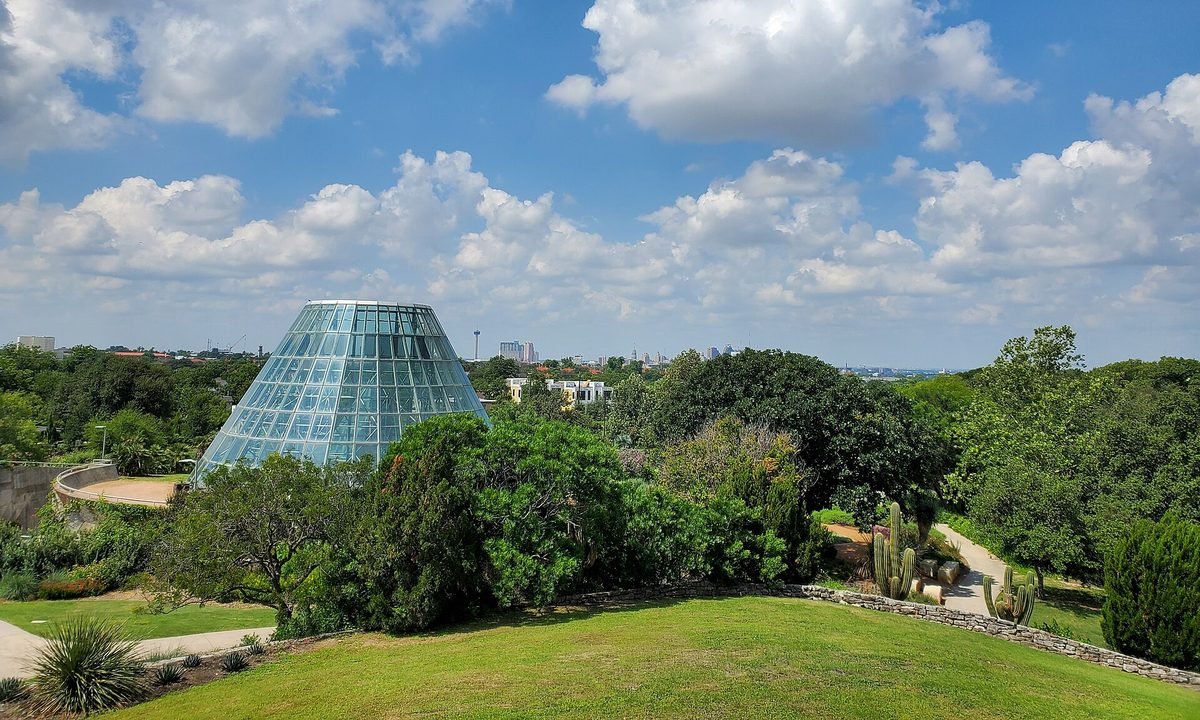
The climate, in numbers that matter to a building
San Antonio is classified as humid subtropical (Köppen Cfa) but sits directly on the boundary with hot semi-arid (BSh), and that position explains almost everything about how houses behave here. The annual relative humidity averages 66.9% — nearly eight points below Houston — and the annual dew point is 55.0 °F, which is a fundamentally different air mass to work with.
What matters more than the averages is the spread. Gulf moisture reaches San Antonio regularly, so mornings can be as saturated as the coast, but the drier continental air to the west means afternoons frequently fall into the forties in relative humidity terms. That daily swing is the practical difference: there are hours most days when outdoor air will genuinely dry a house, which is not true in Houston between May and September.
Rainfall averages 32.38 inches, but San Antonio has one of the more volatile rainfall records in the state — long dry spells broken by very heavy events. For a house, that means alternating cycles of shrinking clay soils and sudden saturation, which is hard on foundations and on the seals around them.
Through the year in San Antonio
| Season | What the outdoor air does | What that does to a house here |
|---|---|---|
| Spring | May and June are the most humid months; Gulf moisture pushes inland regularly | Air conditioning starts working for moisture; a good time to check that it is not short-cycling |
| Summer | Hot with humid mornings and much drier afternoons; highs near 95 °F | Cooling load is heat-driven more than moisture-driven, so the AC usually keeps up on humidity |
| Fall | Dew points drop and the daily swing widens | The best ventilation window of the year — late afternoon air genuinely dries the house |
| Winter | Mild with hard freezes a few times a season | Heating drops indoor humidity noticeably; brief condensation on glass during cold snaps |
What this climate does to a house here
The problems below are the ones that turn up repeatedly in San Antonio specifically, rather than the general list.
-
Morning condensation on cooled surfaces
A house held at 72 °F overnight has cool interior surfaces. When a humid Gulf morning pushes the outdoor dew point into the upper sixties and someone opens a door, water appears on tile, on glass and on any surface the air conditioning has been working on. It is short-lived, and it is why the ventilation advice here is about timing rather than quantity.
-
Closets and rooms with no return air
The most common local mold complaint is a closet or a spare room with a supply register and no return. Air goes in, has nowhere to go, and the room ends up pressurized, poorly mixed and colder than the rest of the house. Growth appears in the corner furthest from the register.
-
Attic and duct condensation in humid spells
Less relentless than in Houston but the same mechanism: when Gulf air pushes in and the attic is humid, cold duct surfaces condense. It shows up as stains after a humid week rather than continuously, which makes it easier to mistake for a leak.
-
Winter dryness that nobody expects in South Texas
Heating during a hard freeze can take a San Antonio house into the low thirties in relative humidity — enough to gap timber floors and split furniture. It does not last long enough for most people to connect it to the heating, but it happens several times each winter.
-
Foundation movement opening the envelope
Expansive clay soils plus a rainfall pattern of drought and deluge move slabs. Cracks that open in a dry spell let humid outdoor air into wall cavities and under floors, where it meets cooled surfaces. The humidity symptom appears indoors while the cause is in the ground outside.
What is your reading telling you?
- Dew point
- 53 °F
- Mold risk, cold walls
- Moderate
Still inside the accepted range, but this is where cold surfaces begin to sweat.
Every fix that works here, cheapest first
The complete ladder for a San Antonio house. The big local advantage is that free measures work here for far more of the year than they do on the coast.
Ventilate in the afternoon, not the morning
On most days the outdoor air is at its driest between about 3 and 6 pm. Twenty minutes of cross-ventilation then genuinely dries a house, while the same twenty minutes at 7 am adds water. Nowhere else in this branch does timing matter as much as it does here.
Control the sources you make
Fan on during and after every shower with the door shut, lids on pans, clothes dryer vented outside, no laundry drying indoors. These are worth several percentage points in a house that is otherwise close to target.
Open closet doors and cross-vent interior rooms
Rooms with a supply register and no return need a path for air to leave — a door undercut, a transfer grille, or simply leaving the door open. This fixes more San Antonio mold complaints than any equipment.
Fan to auto, and use the dehumidify mode
A fan left on continuously re-evaporates condensate from the coil back into the house between cycles. Switching it to auto is free and typically drops indoor humidity by several points on its own.
A second hygrometer, in the room that fails
The living room is not the house. Put a cheap unit in the closet, the spare room or wherever the growth appears and read it in the morning — the gap between that and the main reading is usually the entire diagnosis.
A dehumidifier for the humid weeks
San Antonio does not need one running all summer the way the coast does, but a 30-pint unit set to 50% earns its place during Gulf pushes and in a closed room after any water event. Buy on the 2019 rating rather than an older headline figure.
An ERV for fresh air without the moisture
In a modern airtight house, mechanical fresh air is not optional. An energy recovery ventilator transfers moisture as well as heat, so it brings outdoor air in without importing a humid morning wholesale — the right choice in zone 2A.
A humidifier for the freeze weeks
The reverse problem, a few times a winter. A room humidifier with a humidistat set to 40% covers the handful of weeks when heating takes the house into the low thirties, which is what protects timber floors and furniture.
Seal ducts, add returns, and manage the ground
Sealing duct runs and adding return paths fixes both the pressure imbalance and the condensation. Outside, gutters that discharge clear of the slab and grading that falls away from the house reduce the soil movement that opens the envelope in the first place.
Local construction, and why it changes the answer
San Antonio housing is overwhelmingly slab-on-grade, so the crawl space problems that dominate East Texas and the older parts of Houston are largely absent. What takes their place is duct and register condensation in attics, and the pressure problems that come from ducted systems with too few returns — a very common shortcut in fast-built subdivisions.
The older housing stock inside Loop 410 includes a substantial amount of pier-and-beam construction, and there the standard advice applies: a sealed ground cover under the house does more than adding vents, because in a humid push the outdoor air is the thing making the crawl space wet.
The Hill Country immediately north and west of the city is drier again, and houses a few hundred feet higher and twenty miles west can sit closer to semi-arid conditions than to Gulf ones. If you live on that edge, treat the West Texas guidance on winter dryness as more relevant to you than the coastal guidance on summer moisture.
Common questions
When is the best time of day to open windows in San Antonio?
Mid to late afternoon, roughly 3 to 6 pm, when the daily temperature peak has driven the relative humidity to its lowest point and any Gulf moisture from the morning has usually mixed out. That is the opposite of the advice for a cold climate, where morning is best, and it is one of the genuine local differences worth knowing.
Do I need a dehumidifier in San Antonio or is air conditioning enough?
For most houses, correctly sized air conditioning is enough for most of the summer — the local dew point is low enough that a system running normal cycles keeps up. A standalone dehumidifier earns its place in three situations: a house with an oversized system that short-cycles, a specific room that reads high while the rest of the house is fine, and the humid Gulf pushes in May and June.
Why does my San Antonio house feel dry in winter when the state is supposed to be humid?
Because heating any air that came in from outside collapses its relative humidity, and the state average tells you nothing about a heated room during a freeze. When it is 25 °F outside, the air arriving in your house carries very little water, and warming it to 70 °F can put a room into the low thirties. It is brief, but it is enough to gap a timber floor.
Is a closet with no vent a real problem or just an old wives’ tale?
It is real, and it is one of the most common local causes of mold on clothes. An enclosed volume against an exterior wall with no air movement runs both colder and more humid than the room it opens off — commonly ten to fifteen points higher. Leaving the door ajar and pulling stored items off the exterior wall is a free test that usually settles it in a week.
Sources
- US EPA — Mold and moisture guidance — the 30–50% range and the 10 sq ft remediation threshold
- ASHRAE Standard 55 — Thermal environmental conditions for human occupancy — indoor comfort and humidity limits
- US DOE 10 CFR 430 — Dehumidifier test procedure — the 2019 move to 65 °F rating conditions
- NOAA / NWS 1991–2020 Climate Normals, via the city climate tables on Wikipedia
- US Department of Energy — Building America climate zone definitions
- EPA — Indoor Air Quality: moisture control and mold
- DOE 10 CFR 430 — dehumidifier test procedure (2019 method)