McAllen runs an annual average of 22.31 in relative humidity with a dew point of 98.5 °F. Hold 45–55% indoors and the rest of this page is how.
- Annual rainfall
- 22.31 in
- July high
- 98.5 °F
- Overnight lows, May–Sept
- above 70 °F
- January low
- 52.7 °F
- Indoor target
- 45–55%
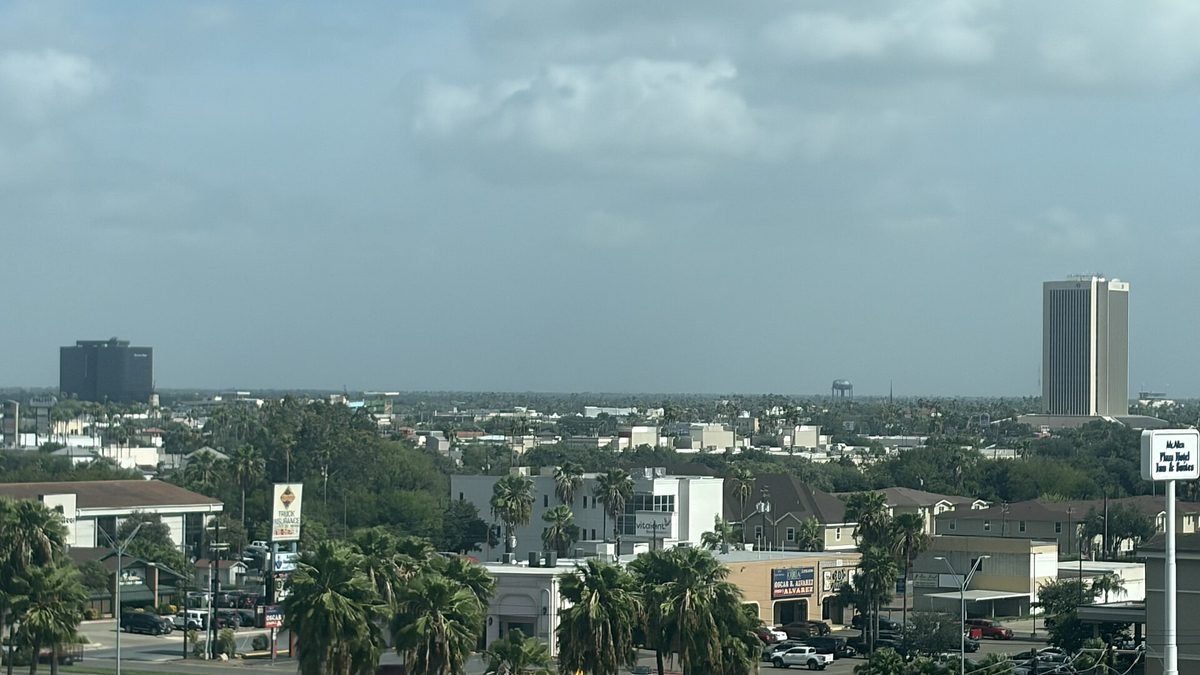
The climate, in numbers that matter to a building
McAllen is classified as hot semi-arid (Köppen BSh) on the strength of its rainfall — 22.31 inches a year, under half what falls on Houston. That classification is genuinely misleading about how the air feels, because the Rio Grande Valley draws Gulf moisture inland regularly and the dew points that come with it are high enough to push heat index values well above the air temperature.
The defining figure is the length of the warm season rather than any single extreme. Average highs sit above 90 °F from May through September, and average overnight lows stay above 70 °F across the same period. A cooling system here works through the night for five months, which is a duty cycle few other American cities impose.
Winter barely qualifies as one. An average January low of 52.7 °F means heating is occasional and brief, so the winter condensation and dry-air problems that dominate North Texas are largely absent. Practically everything about a house here is a cooling-season question.
Through the year in McAllen
| Season | What the outdoor air does | What that does to a house here |
|---|---|---|
| Spring | Warming fast; highs pass 90 °F by May and Gulf moisture pushes inland | Cooling starts early and does not stop. Service the system in March, not June |
| Summer | Very hot with high dew points and overnight lows above 70 °F | Peak load, day and night. Ducts in attics condense; oversized systems leave the house clammy |
| Fall | Slow cooling; the humid pattern persists into October | The season ends later than most of the state. Ventilation windows are rare and short |
| Winter | Mild, dry-ish and brief, with occasional cold fronts | The only weeks when outdoor air is worth letting in, and the time to do maintenance |
What this climate does to a house here
The problems below are the ones that turn up repeatedly in McAllen specifically, rather than the general list.
-
Cooling equipment that never gets a break
With overnight lows above 70 °F for five months, systems run through the night as well as the day. That shortens equipment life, makes correct sizing more consequential, and means a marginal system fails in July rather than limping along.
-
A house that is cold and clammy at once
The standard oversizing problem, made worse by a long season. A system that satisfies the thermostat in a few minutes removes very little water, and over eight months that shortfall accumulates into mildew on stored fabric and a house that never feels dry at any temperature.
-
Duct condensation in hot attics
Attic air here is hot and, when Gulf moisture arrives, wet. Ducts carrying air at 55 °F condense wherever the insulation is gapped, and the water appears as a ceiling stain during a rainless week.
-
Unconditioned storage in a long hot season
Garages, sheds and storage units spend most of the year at outdoor conditions. Over an eight-month season that is long enough for mildew to establish on anything organic, which is why boxes stored in a Valley garage rarely survive a second summer.
-
The rainfall figure that misleads people
Because the region is semi-arid on paper, homeowners and even some contractors assume humidity is not an issue and specify accordingly. It is the dew point rather than the rain gauge that decides what a cooling system has to remove, and that mistake shows up as an undersized moisture strategy.
What is your reading telling you?
- Dew point
- 53 °F
- Mold risk, cold walls
- Moderate
Still inside the accepted range, but this is where cold surfaces begin to sweat.
Every fix that works here, cheapest first
The complete ladder for a McAllen house. Because the season is so long, the priority is a strategy that holds for months without attention rather than an intervention you remember to apply.
Keep the house closed from April to October
Outdoor dew points sit above indoor ones for most of that span. Opening windows in the evening feels right and adds water the system then pays to remove. Check the dew point rather than the temperature.
Remove every source you control
Bathroom fan running during and after showers with the door shut, lids on pans, dryer vented outside, no indoor laundry drying. Over an eight-month season these add up to a very large amount of water.
Give closets and spare rooms an air path
A room with a supply register and no return runs cooler and more humid than the rest of the house. A door undercut, a transfer grille or simply an open door fixes most Valley closet mildew.
Fan to auto, thermostat up a degree
Auto stops the fan re-evaporating coil condensate back into the house. A slightly higher set point produces longer runtimes, and it is runtime rather than temperature that removes moisture.
Check where the extraction ducts terminate
Bathroom and kitchen ducts that stop in the attic put every shower into the hottest part of the building. Following each one physically takes an hour and sometimes solves the whole problem.
A dehumidifier for the long season
A 30 to 50 pint unit under the 2019 rating, set to 50%, run from spring to fall. In a large house that will not hold under 55%, a ducted whole-house unit lets the cooling system handle heat and the dehumidifier handle water.
An ERV for fresh air in a tight house
Newer Valley construction is airtight enough to need mechanical ventilation. An energy recovery ventilator transfers moisture as well as heat, which is the correct choice in zone 2A; an HRV brings the outdoor dew point straight in.
Right-size the cooling system at replacement
With a duty cycle this long, a variable-speed or two-stage system sized from a real load calculation is the highest-value decision available. It runs longer at lower capacity, and long runtimes are how a house gets dry.
Seal and insulate the ducts, or condition the attic
Sealing duct joints and restoring insulation stops the condensation and recovers cooling capacity at once. An unvented conditioned attic removes the hot humid space the ducts pass through entirely, which in this climate is one of the most effective envelope changes available.
Local construction, and why it changes the answer
Valley housing is almost universally slab-on-grade with ducted systems in vented attics, so the crawl space problems of East Texas and older Houston are absent and attic problems take their place. Where a house has a slab, the other consequence is that anything stored directly on a garage or utility floor sits on a surface cooler than the summer air and condenses underneath.
The long cooling season changes the economics of equipment. A machine running eight months a year accumulates hours far faster than the same machine in Dallas, so efficiency and correct sizing pay back sooner, and neglected maintenance shows up sooner too. Annual service before April rather than after a failure in July is a genuine local difference.
It is worth restating the classification trap. McAllen is semi-arid by rainfall and humid by dew point, and a house responds to the second. Any specification argument that starts from the rain gauge — "we only get 22 inches, humidity is not our problem" — will produce a moisture strategy that is too small for the climate the building actually experiences.
Common questions
How can McAllen be semi-arid and humid at the same time?
Because the two words measure different things. The Köppen classification is driven by rainfall against evaporation, and 22 inches a year in a hot climate qualifies as semi-arid. Humidity is about the water in the air, which arrives here from the Gulf regardless of whether it falls as rain. A house responds to the air, not the rain gauge, which is why the classification is the wrong guide to what equipment you need.
Should my air conditioner run all night in the Valley?
In summer it effectively will, because average overnight lows stay above 70 °F from May through September and the moisture load does not fall at night either. What matters is that it runs in reasonable cycles rather than short bursts — a system short-cycling at 2 am is removing heat and leaving water behind, which is how a house ends up cold and damp by morning.
Do I need a dehumidifier if I already run air conditioning eight months a year?
Only if the humidity reading stays above 55% while the system is satisfied. That is the test. If it does, the system is oversized or the moisture load is larger than it was designed for, and a dedicated dehumidifier is a cheaper fix than replacing the cooling equipment. If the reading sits in the forties, the system is doing its job and a dehumidifier would add cost and heat for nothing.
What should I do about a garage full of stored boxes?
Get them off the floor and out of cardboard. A garage here spends most of the year at outdoor conditions, and the slab stays cooler than the air, so cardboard sitting on it wicks moisture from underneath while mildew works on the contents. Sealed plastic bins on shelving solve most of it; anything genuinely valuable belongs in conditioned space.
Sources
- US EPA — Mold and moisture guidance — the 30–50% range and the 10 sq ft remediation threshold
- ASHRAE Standard 55 — Thermal environmental conditions for human occupancy — indoor comfort and humidity limits
- US DOE 10 CFR 430 — Dehumidifier test procedure — the 2019 move to 65 °F rating conditions
- NOAA / NWS 1991–2020 Climate Normals, via the city climate tables on Wikipedia
- US Department of Energy — Building America climate zone definitions
- EPA — Indoor Air Quality: moisture control and mold
- DOE 10 CFR 430 — dehumidifier test procedure (2019 method)